Make your researchers findable
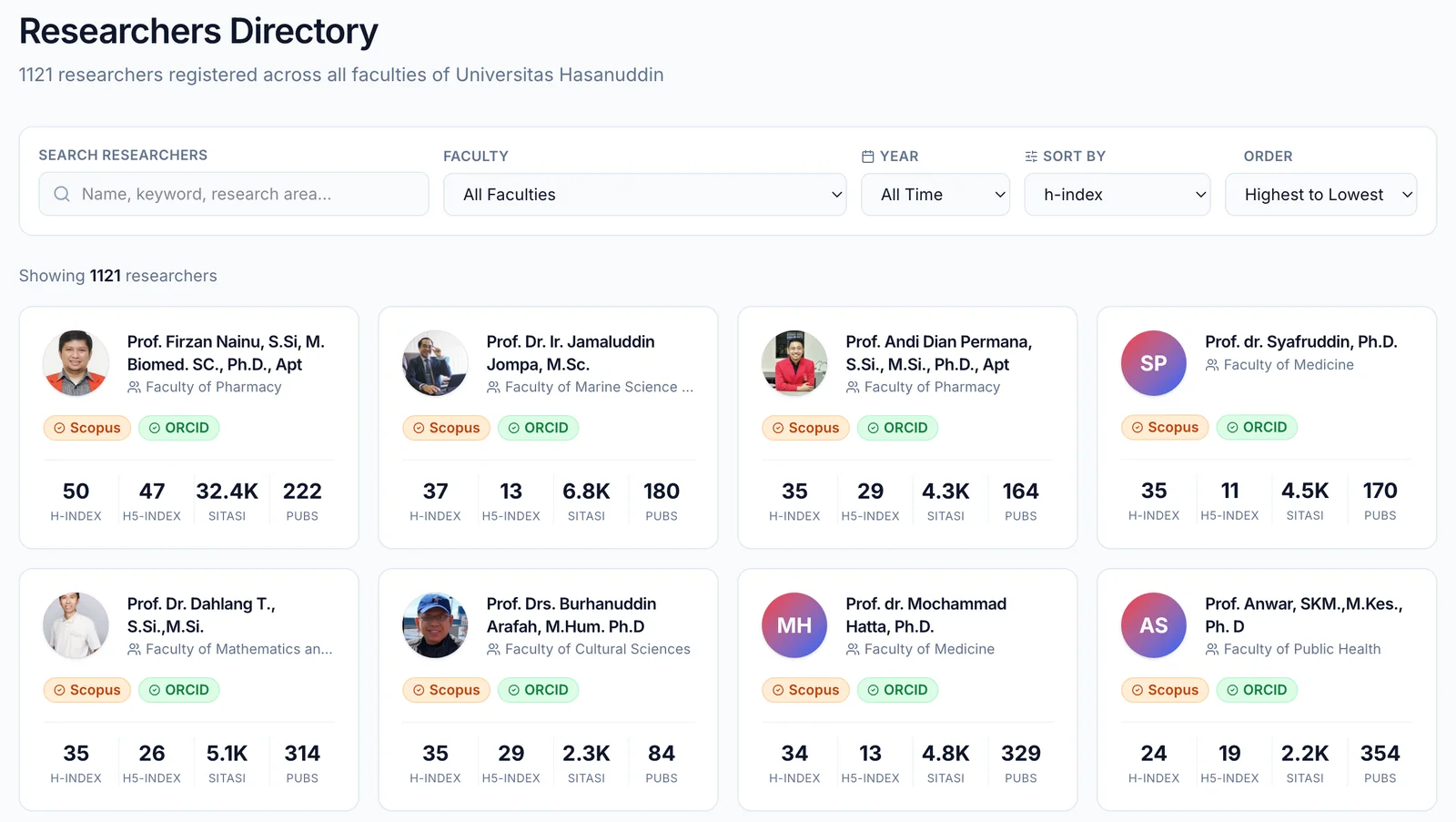
Funders, industry partners, journalists and prospective students look for expertise by topic, not by faculty. Discover RIMS publishes a profile for every researcher, a directory searchable by research area and a map of who works with whom, all kept current from your institution’s publication record.
- Public pages
- Profiles, directory, network map, publication search
- Kept current by
- Scheduled sync from OpenAlex and ORCID
- Live example
- discover.unhas.ac.id
- Researcher self-editing
- Not yet; administrators maintain profiles
Expertise that cannot be found is not funded, cited or called
Most universities already publish staff pages, but they are written once and rarely updated. A partner looking for coral-reef ecologists, or a journalist who needs a dengue epidemiologist by this afternoon, will not find them on a faculty staff list.
Visibility depends on three things: a page per researcher that search engines can index, a way to search by topic across faculties, and data that stays current without asking researchers to update it. Our guide to improving university research visibility covers the wider strategy.
What the portal gives you
Every page is public, and built from the same record your research office uses internally.
-
Researcher profiles
A page per researcher with ORCID and Scopus badges; h-index, h5-index, citations and output; a journal quartile breakdown; publications per year; a research fingerprint of their main topics; their co-author network; a map of partner countries; and their full publication list. Each profile has its own description for search engines.
-
Directory search
Search researchers by name, research-fingerprint keyword or faculty. Filter by faculty and by publication year, and sort by h-index, citations, publications or name.
-
Co-author network map
An interactive map of co-authorship across the institution, with name search, a year-range slider, keyword clusters, a cross-faculty view and a path finder that shows how two researchers are connected through their co-authors.
-
Publication search
Keyword search across titles, authors, abstracts, keywords and journals, filtered by type, year, journal quartile and SDG. Every publication can be cited in APA, MLA, Chicago, Harvard, Vancouver, BibTeX or RIS.
-
Contact without exposing email
Visitors can message a researcher through a form on their profile. The researcher’s email address is not shown on the page.
-
Faculty pages
A page per faculty with its researcher count, citations and publications per year.
What it does not do
Stated plainly, so you can plan the rest of the work.
- Researchers cannot yet sign in to edit their own profile. Administrators add researchers, set their identifiers and correct their records.
- Search matches keywords in names, research keywords, titles and abstracts. It is not semantic search.
- Profiles show the publications the platform finds through OpenAlex, ORCID and Crossref. Work none of them index, such as some books, reports and creative outputs, does not appear.
- CV export to PDF is available to administrators, not to the public.
Where the data comes from
The portal is only as current as its sources. These are the ones it draws on.
- Publications and citations OpenAlex Publications, citation metrics, research fingerprints, co-authors and partner countries.
- Researcher identity ORCID Identifies each researcher, and adds works from their public ORCID record.
- Author IDs and indexed journals Scopus The Scopus Author ID badge on each profile, and the Scopus flag on publications.
- Journal quartiles Scimago Journal quartiles behind each profile’s Q1–Q4 breakdown and the quartile filters.
Further reading
- Insight How to Improve Your University's Research Visibility Strong research stays invisible because it is fragmented. Four levers, why "tell researchers to update" fails, and why visibility decays.
- Guide Researcher Profiles That Rank in Google Scholar and Search Research that cannot be found does not build reputation. What makes researcher profiles discoverable — and why only reconciled data makes it sustainab...
- Insight Open Science Data and Your Institution's Research Profile Why ignoring open-science sources understates performance — and how to add coverage without sacrificing quality or trust.
Questions about the researcher portal
Not covered here? Ask us directly
No. Profiles are built from OpenAlex and ORCID and refreshed on the schedule your administrators set. Researchers only need an ORCID iD; keeping their ORCID works public helps fill gaps.
Yes. Administrators can hide individual publications, and they stay hidden at later syncs.
They are public pages with their own titles and descriptions, which search engines can crawl and index. Where a profile ranks for a researcher’s name or topic also depends on the rest of the web, so no one can promise positions.
Yes. Universitas Hasanuddin’s portal at discover.unhas.ac.id runs on Discover RIMS and is public.