OpenAlex: the publication record behind every profile
Discover RIMS finds each researcher in OpenAlex by their ORCID iD, or by their Scopus Author ID when they have no ORCID iD, and pulls every work attributed to them. The citation counts, h-index, research topics and collaborator countries on a profile all come from that record.
- Role
- Main source of works and citations
- Matched by
- ORCID iD, then Scopus Author ID
- Refresh
- Manual, hourly, daily or weekly
- Licence
- Data released under CC0
What Discover RIMS takes from OpenAlex
For each researcher, the platform requests their OpenAlex author record and every work attributed to it.
| Data | What it is used for |
|---|---|
| Works | Title, year, type, DOI, journal and ISSN, volume, issue, pages, language and abstract. The abstract is rebuilt from OpenAlex’s word index. |
| Authorships | The authors of each work, and the countries and institutions of co-authors outside your institution. These feed the collaboration maps. |
| Citations | The citation count of each work and its citations by year, refreshed at every sync. |
| Author metrics | h-index, i10-index, two-year mean citedness, total citations and works count. The h5-index is calculated by the platform from the last five years of works. |
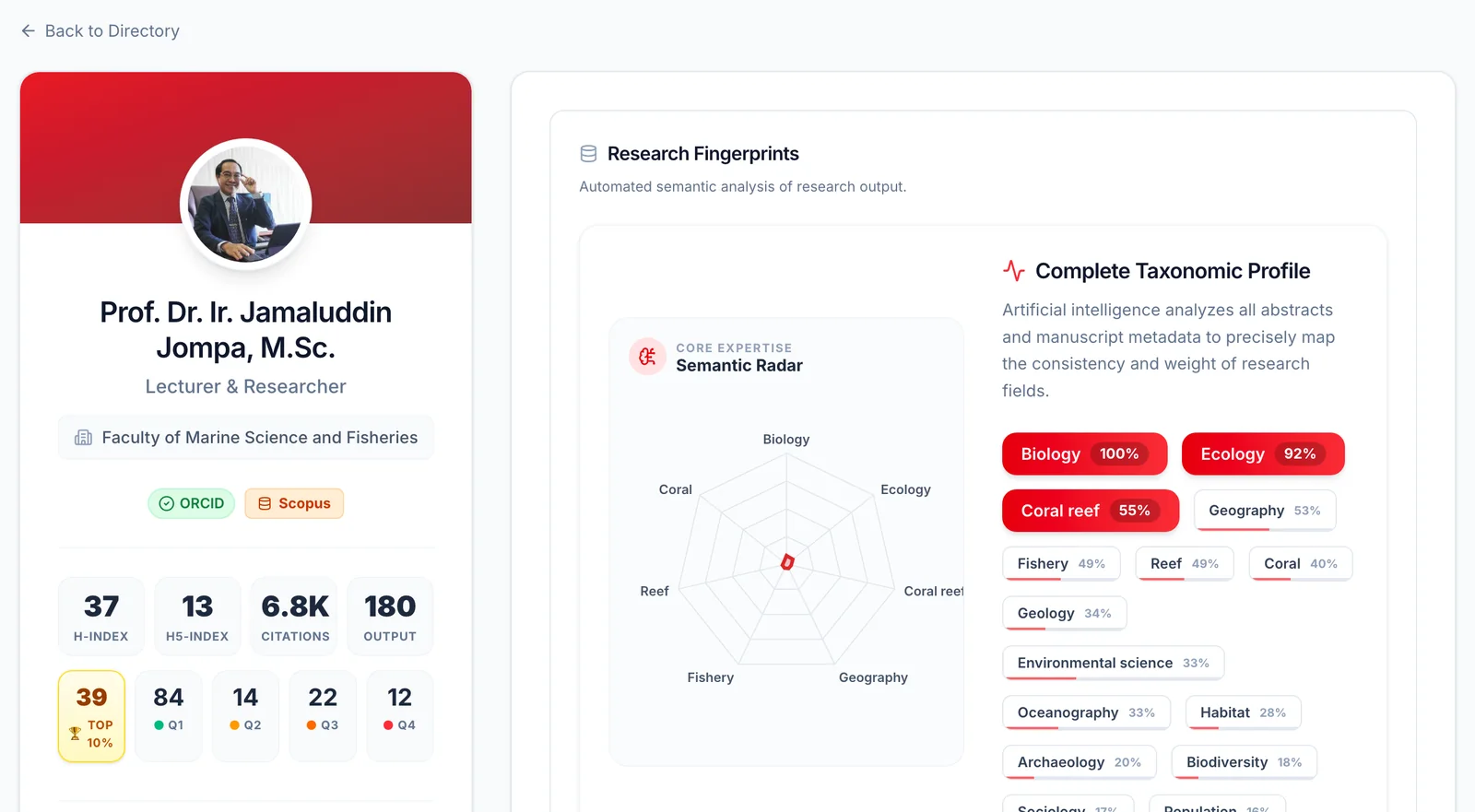
| Topics and concepts | Topics and concepts for each work, stored as keywords. A researcher’s strongest concepts form the research fingerprint on their profile. |
| SDG labels | Sustainable Development Goals assigned by OpenAlex’s classifier, used for SDG filters and the SDG distribution in analytics. |
| Open access and retractions | Whether a work is open access, and whether it has been retracted. |
| Funders | The names of funders listed on the work. |
How a researcher’s works are matched
Matching starts from an identifier, not a name. If a researcher has an ORCID iD, the platform asks OpenAlex for the author with that iD. If not, it uses their Scopus Author ID. A researcher with neither identifier has no synced publications, so identifiers are the first thing to get right.
Works are de-duplicated by DOI first, then by OpenAlex ID. A paper co-authored by two of your researchers is stored once and linked to both profiles.
What happens at each sync
Administrators choose manual, hourly, daily or weekly synchronisation. Each scheduled run refreshes the 200 researchers who were synced longest ago, so a large institution is covered over successive runs. An administrator can also start a sync immediately, for everyone or for one faculty, or force a sync for a single researcher.
At each sync, citation counts, citation trends and the retraction flag are updated. Other fields are filled only where they are empty, so corrections an administrator makes are not overwritten. Works an administrator has hidden stay hidden, and works that OpenAlex no longer attributes to the researcher are removed from their profile.
Why OpenAlex rather than a subscription index
OpenAlex is an open catalogue of scholarly works, and its data is released under a CC0 public-domain licence. Building the record on it means the platform does not depend on a commercial citation-index subscription, which matters for institutions that do not license one.
The trade-off is that figures will not match Scopus or Web of Science exactly: coverage, author disambiguation and citation counting differ between indexes. Where a figure has to match an external source, take it from that source, and use Discover RIMS to track your own output consistently over time. Our comparison of OpenAlex and Scopus coverage goes into the differences.
Other sources in the record
No single index covers a university’s output. Each source fills a gap the others leave, and Crossref catches DOIs the rest miss.
- Researcher identity ORCID The anchor for each researcher. Their ORCID iD finds their works in OpenAlex, and the DOIs on their public ORCID record fill gaps.
- Author IDs and indexed journals Scopus Scopus Author IDs identify researchers who have no ORCID iD, and the Scopus source list flags publications in Scopus-indexed journals.
- Journal quartiles Scimago Journal quartiles from the SCImago Journal Rank (SJR), behind the Q1–Q4 breakdowns, quartile filters and top-10% journal flags.
Further reading
- Insight OpenAlex vs Scopus: Understanding Coverage Differences OpenAlex covers 250M+ works (open, free API); Scopus covers ~90M (curated, commercial). Each source misses what the other captures — why a RIMS must u...
- Insight Researcher-Level Metrics: h-index, FWCI and What They Really Tell You h-index and Field-Weighted Citation Impact balance different things — and both fail on poor data. How to use researcher-level metrics responsibly.
- Guide How a RIMS Ingests Data from Scopus, OpenAlex, ORCID, Crossref and Scimago A modern RIMS ingests from five sources: Scopus, OpenAlex, ORCID, Crossref, and Scimago. Why multi-source reconciliation — not dashboards — determines...
Sources: OpenAlex pricing and licence · OpenAlex SDG classification · OpenAlex authorships
Questions about the OpenAlex integration
Not covered here? Ask us directly
No subscription is needed to use OpenAlex data, which is released under CC0. OpenAlex meters API use with a free daily allowance and charges for use above it; the sync volume for an institution of your size is part of scoping.
Each index covers a different set of publications and counts citations from a different set of sources. The h-index on a Discover RIMS profile is OpenAlex’s figure, so it is usually close to the Scopus or Google Scholar figure but not the same.
No. Profiles show h-index, h5-index, i10-index, total citations and two-year mean citedness. Field-weighted citation impact is an Elsevier metric; our guide explains how FWCI and the h-index are calculated.
Their profile shows no synced publications until one is added. Administrators can add identifiers one at a time or by spreadsheet import, and the platform can find ORCID iDs for researchers whose names exactly match an OpenAlex author at your institution.
Yes. An administrator can hide a work from a profile, and it stays hidden at later syncs.