ORCID: one iD that anchors each researcher
An ORCID iD is the most reliable way to tell apart two researchers with similar names. Discover RIMS uses it as the primary key for finding a researcher’s works, then reads the DOIs on their public ORCID record to catch publications the main source missed.
- Role
- Primary researcher identifier
- Access
- Read-only, public record data
- Writes to ORCID
- No
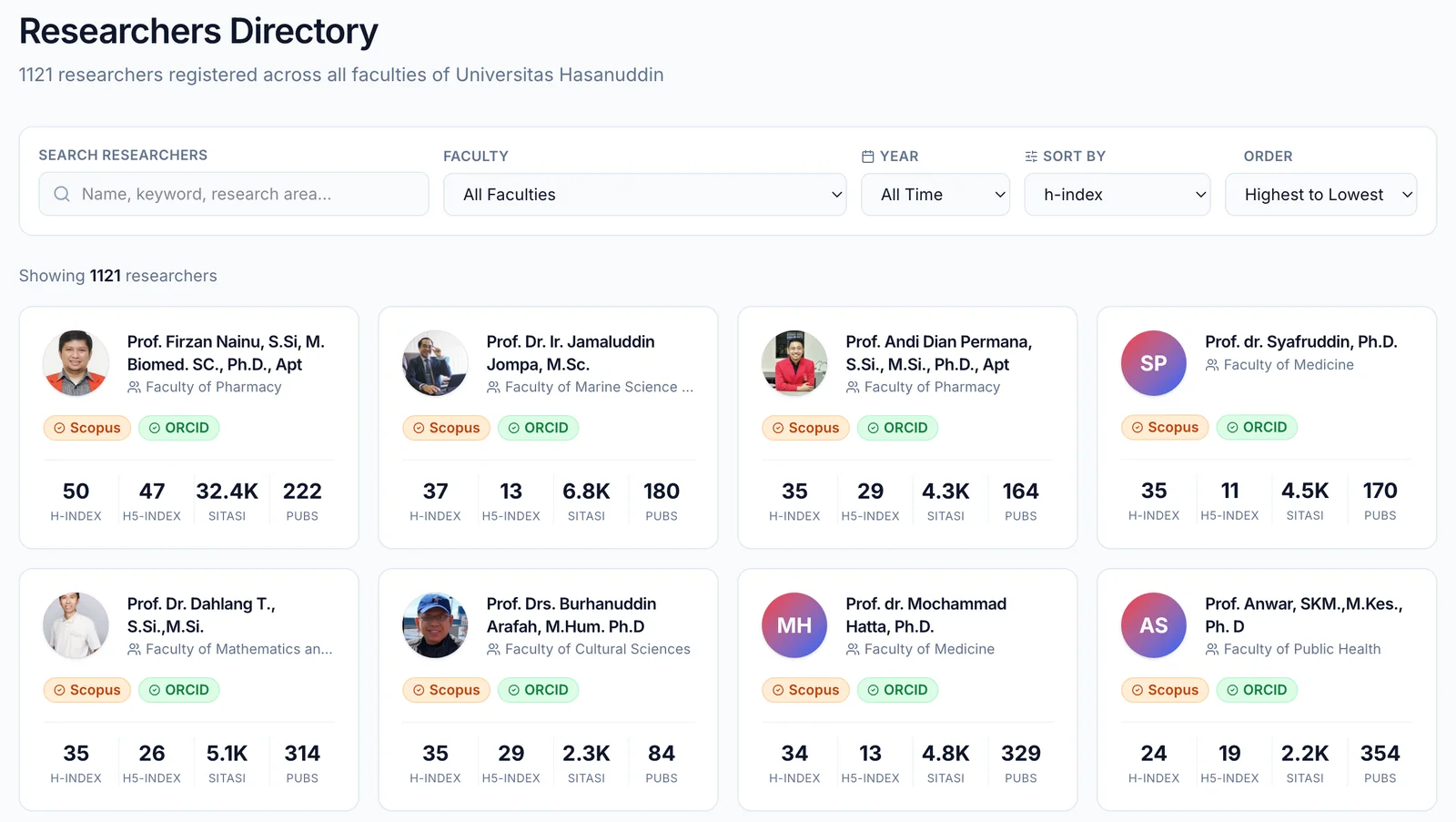
- On the profile
- ORCID badge linking to the record
What Discover RIMS takes from ORCID
The platform reads public data from each researcher’s ORCID record. It does not write to ORCID.
| Data | What it is used for |
|---|---|
| ORCID iD | The key used to find the researcher’s author record in OpenAlex, and the link behind the ORCID badge on their profile. |
| Works with DOIs | DOIs on the public record that are not yet linked to the profile. Each is matched to a work already in your record, fetched from OpenAlex, or, failing that, fetched from Crossref. |
Why the iD matters more than the name
Name matching fails on common names, transliterations, initials and name changes. Starting from an ORCID iD means the platform asks OpenAlex for one specific author rather than everyone with a similar name.
For researchers without an ORCID iD, the Scopus Author ID is used instead. Researchers with neither have no synced publications, which makes ORCID adoption the most useful data-quality step for most institutions. Our guide to institutional ORCID adoption covers how to raise coverage.
Filling gaps from the ORCID record
Researchers often list works on ORCID that an index has not attributed to them. At each sync, the platform reads the DOIs on the public ORCID record and links any that are missing: from works already in your institution’s record, from OpenAlex by DOI, or from Crossref when OpenAlex does not have the DOI.
Finding the iDs you do not have yet
Most institutions start with incomplete identifiers. The platform can look up OpenAlex authors at your institution who have an ORCID iD and assign them to researchers whose names match exactly. Administrators can also add or correct iDs one at a time, or import them from a spreadsheet.
The analytics view reports how many researchers have an ORCID iD and how many have a Scopus Author ID, so you can track coverage as it improves.
Other sources in the record
No single index covers a university’s output. Each source fills a gap the others leave, and Crossref catches DOIs the rest miss.
- Publications and citations OpenAlex The main source: every work and citation count in a researcher’s record, the countries of their co-authors, and the h-index and i10-index on their profile.
- Author IDs and indexed journals Scopus Scopus Author IDs identify researchers who have no ORCID iD, and the Scopus source list flags publications in Scopus-indexed journals.
- Journal quartiles Scimago Journal quartiles from the SCImago Journal Rank (SJR), behind the Q1–Q4 breakdowns, quartile filters and top-10% journal flags.
Further reading
- Guide How to Find an ORCID iD: A Practical Guide How to find your own ORCID iD, look up someone else's, and reconcile ORCID across an institution — without manual searching for thousands of researche...
- Insight Scopus Author ID and ORCID Explained for Research Offices Persistent author identifiers — Scopus Author ID and ORCID — are the foundation of credible researcher metrics. What each is, how to find them, how a...
- Guide Institutional ORCID Adoption: A Practical Strategy ORCID is the single most effective lever for research-data accuracy. A practical institutional adoption strategy that actually sticks.
Sources: ORCID Public API · ORCID Member API
Questions about the ORCID integration
Not covered here? Ask us directly
No. It reads public data only. Writing to ORCID records requires the ORCID Member API and each researcher’s permission, which the platform does not use today.
Not today. Profiles are maintained by administrators, and there is no researcher login.
Only works the researcher has made public can be read. Their iD can still be used to find them in OpenAlex.
Our step-by-step guide shows how to find an ORCID iD, including someone else’s.